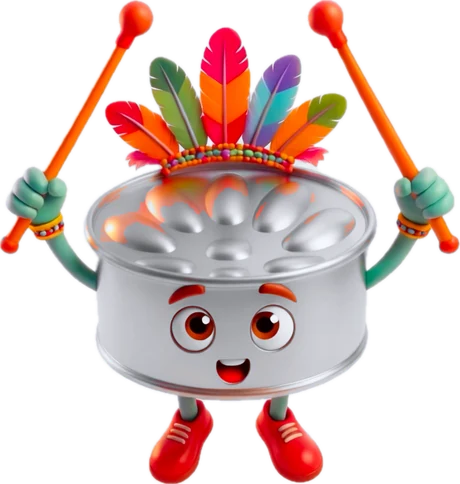
Teach a small child to play the steel pan.
Play Yuh Pan is a first steel pan for young children — the national instrument of Trinidad & Tobago, with no music to read and no letters to know. Every note has its own colour and shape, and the next one glows. Tap the glow, and a song comes out.
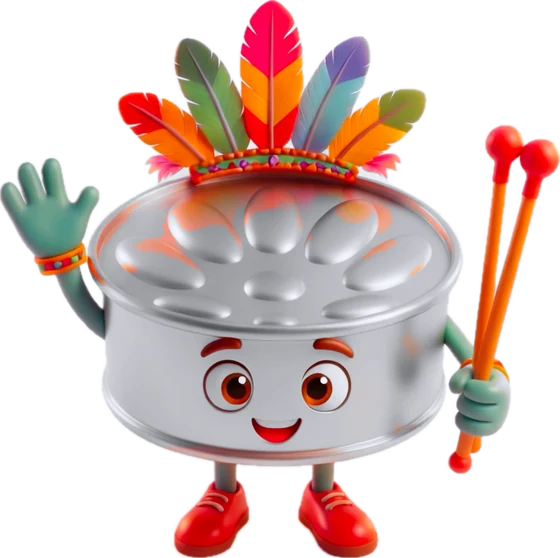
C up to C around the rim, two sharps, and six smaller high notes in the middle. Colour and shape both carry the note, so a child who cannot read yet — or who cannot tell the colours apart — can still follow along.
Every child learns a song differently.
The same song comes in five styles, so a child who freezes at a moving target can take all the time in the world, and a child who is ready for timing can play to a click.
- Wait for meThe song waits for each tap, however long it takes
- Big padsGiant notes fly onto the pan, easy for small fingers
- RingsA circle closes in to show when to tap
- Falling notesNotes drop down lanes to the pan
- On the beatPlay along with a woodblock click

A map of 49 real towns, one lesson each.
The journey runs from the North West through the North East, Central, South and West, and ends in Tobago — Port of Spain, Arima, San Fernando, Scarborough and forty-five more. Finish a town and a sticker goes in the sticker book.
- Six regionsNorth West, North East, Central, South, West, Tobago
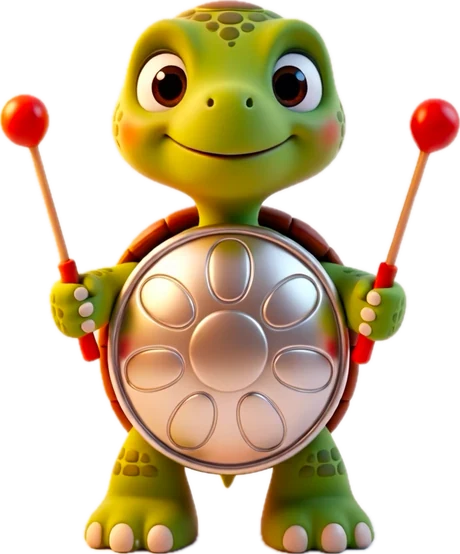
- A palPingo, a pan in a carnival headdress, or Tingo the turtle
- StickersEvery town finished earns one for the sticker book
- Spaced reviewLater towns quietly draw notes from songs already learned

Tingalayo, Mango Walk, Brown Girl in the Ring.
Lessons mix the nursery songs a small child already knows with Caribbean folk songs — Tingalayo, Linstead Market, Brown Girl in the Ring, Mango Walk — plus Hello Good Day, a song written for the app. New island songs are added over time.
- Folk songsCaribbean traditionals, not generic kids' music
- Nursery songsFamiliar tunes to start on
- Jam TimeA free-play pan for making up tunes
- RecordingWith the full unlock, record a tune and play it back

The same words a pannist uses.
Children learn techniques by their real names, one at a time, so what they pick up here is what they would be told in a panyard.
Make a note sing long
Pannists tap one note very fast so it rings on. Hold the note down and it rolls.
Listen, then answer
One player calls and the others answer. Echo games play a phrase, then wait for the child to play it back — the way pannists learn by ear.
Soft and loud
Small beads are soft, big beads are loud. The same note, played two ways.
Two sticks, two notes
Two notes struck together. Both glow, and both have to be tapped at once.
A flick before the note
A tiny quick note right before the main one. Flick, then land.
End it strong
Pannists finish a song on one big last note. The app asks for it by name.
Nothing to sign up for, nothing collected.
There are no ads, no accounts and no analytics. Purchases and settings sit behind a parent gate, and the play-time limit waits for a natural break in the lesson instead of cutting a song off.
- Parent gatePurchases and settings are behind it
- Play-time limitOptional, and it waits for a natural break
- Left-handedThe whole layout flips
- Older kidsTurn on letter names instead of shapes
- PrivateNo ads, no accounts, no data collection

Play the first region free.
The first region — nine towns — and four Island Songs are free to play, with no account and no ads. Unlock the whole journey with a one-time purchase, or weekly or monthly if you would rather not buy it outright.
- Nine towns and four Island Songs free
- All five play styles from the start
- Full unlock: all 49 towns and every song
- Full unlock: record your own tunes in Jam Time
- One-time purchase, or weekly or monthly
Questions, answered.
What age is Play Yuh Pan for?
It is built for children around three to nine. Nothing has to be read: the next note glows, the prompt shows a shape and a colour, and a spoken voice names the note. Older children can switch on letter names instead.
Does my child need to read music?
No. There is no notation anywhere in the app. Every note on the pan has its own colour and its own shape — a circle, a star, a moon, a heart — and the child matches the shape in the prompt to the shape on the pan.
What is a steel pan?
The steel pan, or steel drum, is the national instrument of Trinidad & Tobago. It is played with two sticks on a bowl of tuned notes, and the note faces are hammered into the surface rather than laid out in a row like piano keys. Play Yuh Pan uses a simplified child's pan: C up to C around the rim, plus two sharps, and six smaller high notes in the middle.
Is any of it free?
Yes. The first region, nine towns, plus four Island Songs are free to play, with no ads and no account.
Is there a subscription, or can I just buy it?
Either. One purchase unlocks the whole journey for good, and there are also weekly and monthly options that unlock exactly the same thing.
Does it collect any data about my child?
No. There are no accounts, no sign-ins, no ads and no analytics. Progress stays on the device, and purchases and settings are behind a parent gate.
Can I limit how long my child plays?
Yes. A grown-up can set a play-time limit in minutes. When the time runs out the app waits for a natural break in the lesson before stopping, so a song is never cut off mid-phrase.
Does it work for a left-handed child?
Yes. A setting flips the whole layout for left-handed play.
Which songs are in it?
Nursery songs a child is likely to know, Caribbean folk songs including Tingalayo, Linstead Market, Brown Girl in the Ring and Mango Walk, and Hello Good Day, which was written for the app. More island songs are added over time.
What devices does it run on?
iPhone and iPad running iOS 17 or later.
How children learn the steel pan in Trinidad and Tobago · How a steel pan is actually laid out and tuned · More apps from Hello Good Day · Send us a question about Play Yuh Pan
Play yuh pan.
Nine towns, four Island Songs and all five play styles, free to start.